"The Superintendent shall not operate without a strategy to ensure student motivation to want to be in school."
31,469
STUDENT RESPONSES
1,003,000+
WORDS OF AUTHENTIC VOICE
127
HOURS OF STUDENT SPEECH
31,469 student responses analyzed127 hours of authentic student speech1,003,000+ words captured10 SDUSD schools8 human skills competencies measured56.6% of responses scored Distinguished or Exemplary800+ trusted adults identified by nameGuardrail 2 · Student Motivation31,469 student responses analyzed127 hours of authentic student speech1,003,000+ words captured10 SDUSD schools8 human skills competencies measured56.6% of responses scored Distinguished or Exemplary800+ trusted adults identified by nameGuardrail 2 · Student Motivation
STUDENT VOICE
Hear From Our Students
Real SDUSD students, in their own words. Each voice reveals the motivation architecture that traditional instruments were never designed to capture.
Ellie
Mira Mesa High · Grade 9
Purpose
“The foundation to my everything is really my family, my friends. They're my why.”
Purpose
Grit
VIDEO · 1:42
Ethan
Mira Mesa High · Grade 11
Growth Mindset
“I think everybody had a time in their life where they were struggling with this — that's how I know I can push through.”
Self-Control
Growth Mindset
VIDEO · 1:59
Elijah
Henry High · Grade 11
Grit
“We said, no, it's fine. We're going to just keep trying other things until something works.”
Purpose
Grit
Growth Mindset
VIDEO · 1:47
Charlene
Mira Mesa High · Grade 11
Purpose
“We're impacting people far beyond what I often think is possible as a high school student.”
Purpose
Grit
VIDEO · 1:28
Noah
Mira Mesa High · Grade 11
Growth Mindset
“Seeing the potential of what could happen motivates me to get better.”
Grit
Growth Mindset
VIDEO · 1:04
Azaria
Mira Mesa High · Grade 10
Purpose
“People around me who like seeing my face and hearing my voice — that's what gets me out of bed.”
Purpose
Self-Control
AUDIO · 0:37
Adieny
Hoover High · Grade 9
Growth Mindset
“The people I seek feedback from are teachers, mentors, my close friends — they see things I might miss.”
Perspective-Taking
Growth Mindset
AUDIO · 0:53
Mackenna
Henry High · Grade 10
Compassion
“The gift I've given is being a very trustworthy friend — that feels more valuable than anything physical.”
Gratitude
Compassion
AUDIO · 1:56
Nathan
Mira Mesa High · Grade 11
Growth Mindset
“I'm thankful I live in a place where the opportunity I have is better than what most people might get their whole life.”
Perspective-Taking
Growth Mindset
Gratitude
AUDIO · 1:45
Marvin
Mira Mesa High · Grade 12
Purpose
“The car has to keep going. I can't just stop midway through the trip and expect everything to be easy.”
Purpose
Grit
Growth Mindset
AUDIO · 0:59
PURPOSE · GRADE 9
Ellie
Mira Mesa High
Purpose
GUARDRAIL 2
MotivationSTRONG
BelongingSTRONG
Effort→ResultsSTRONG
Managing OverwhelmSTRONG
EVIDENCE LIBRARY
SCANNING FOR TEXTUAL EVIDENCE...
▶
0:00
1:42
VOICE INTELLIGENCE · 0 / 8
PURPOSE
GRIT
GROWTH MINDSET
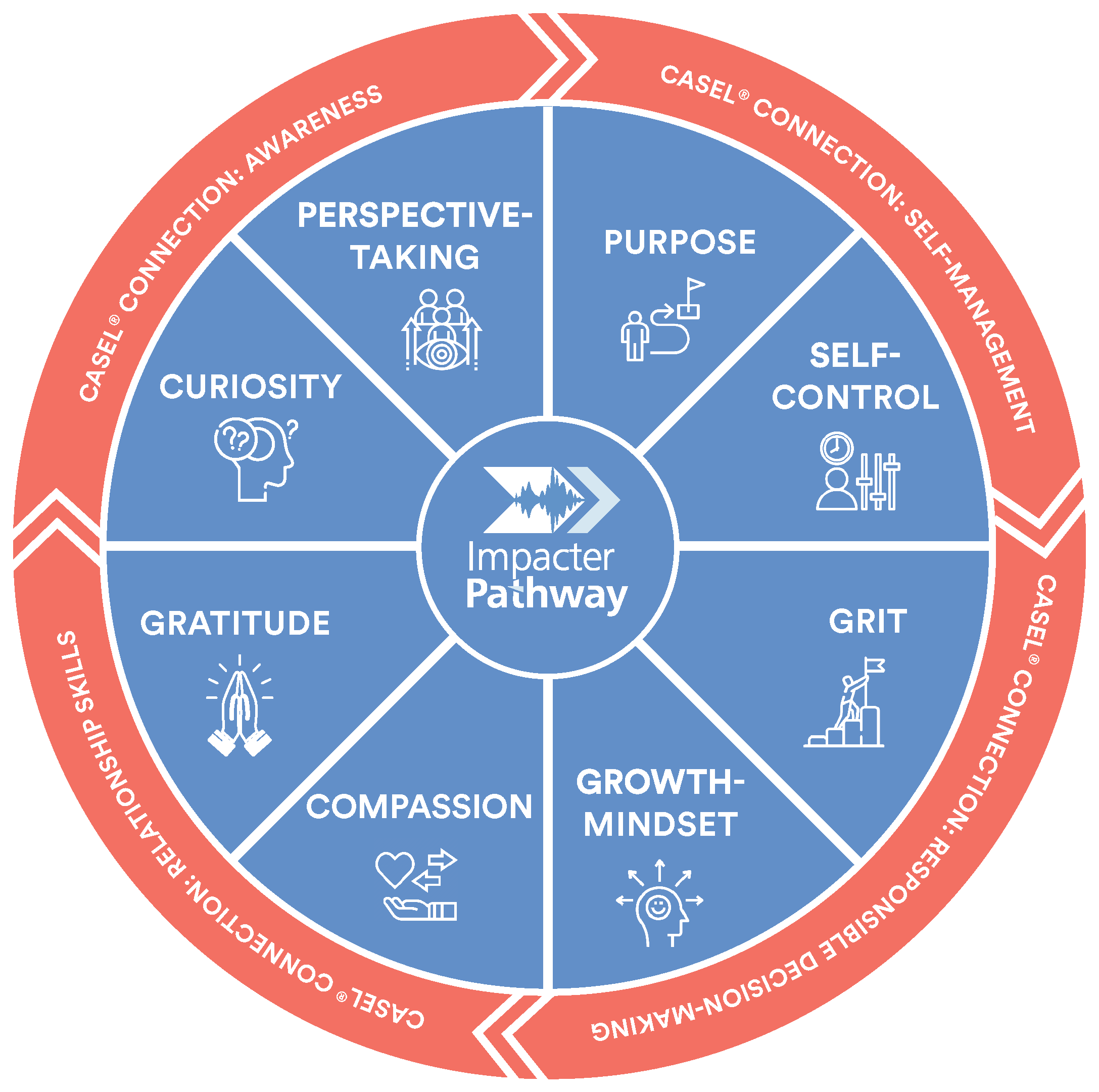
PERSPECTIVE-TAKING
SELF-CONTROL
CURIOSITY
GRATITUDE
COMPASSION
VOICE SIGNAL
ML DETECTION · 0 LOCKED
· · ·
· · ·
· · ·
· · ·
· · ·
SPOTLIGHT STUDENT · DEEP DIVE
One Response. Five Attributes.
This is what 2 minutes of authentic student voice reveals that 5 survey questions cannot.
PURPOSE · HOOVER HIGH · GRADE 11
Christopher
5
OF 8 ATTRIBUTES
ANNOTATED TRANSCRIPT · 2:00 AUDIO RESPONSE
I think what drives me is like fear of failing. I've always had this immense fear of like being a failure in life. And I know failure is defined in many different ways and people have their own definitions of how they define failure. But to me, I come from a background of a family who has no people who have graduated college, has a lot of people that are struggling with financial issues and family issues. And when you grow up in that environment, it like forces you to become a better version of yourself. So every morning I wake up and one of my main motivators is definitely my auntie. She drives me to become a better person. She drives me to push myself because she's been through high school, graduated with honors, and she's told me that if she can do it, I can do it. She drives me to become an overachiever. Sometimes I even take on tests that I know are too big for me, but I end up doing anyways because I just want to accomplish something bigger than myself. My main goal in life is to be successful and make my family proud. I've wanted to make a name for myself. I've wanted to be someone that people in my family could name out and say, yeah, he's that person you could look up to. And that's what motivates me every morning to wake up and strive for what I want.
VOICE INTELLIGENCE ANALYSIS
Christopher's response reveals a motivational architecture the district's survey instruments are structurally unable to capture. His drive is not the confidence-based 'I believe I can improve' that a Likert scale measures — it's built on fear of failure, first-generation family obligation, and deep identification with a trusted adult who models possibility. He demonstrates five of IMPACTER's eight anchor attributes in a single two-minute response.
KEY GUARDRAIL 2 INSIGHT
"Voice data reveals a student building purpose from adversity — with a named trusted adult the system may not have known existed."
ATTRIBUTES DETECTED
Purpose
Grit
Growth Mindset
Perspective-Taking
Gratitude
GUARDRAIL 2 ALIGNMENT
Motivation to Be in SchoolStrong
Sense of BelongingStrong
Effort → ResultsModerate
Trusted Adult
Explicit: Auntie (off-campus)
EQUITY SIGNALS
•First-generation college student
•Financial hardship
•Family challenges
Click to highlight:
Purpose
Grit
Growth Mindset
Perspective-Taking
Gratitude
SOFG · BOARD FRAMEWORK
Where Guardrail 2 Fits
San Diego Unified's Student Outcomes Focused Governance structure sets four student outcome goals and five superintendent guardrails. This report focuses on Motivation.
GOALS
GUARDRAILS
The Superintendent shall not operate without a strategy to ensure student motivation to want to be in school. Monitored through extracurricular participation rates for Spotlight students in grades 3, 6, and 9.
2025–26 MONITORING CALENDAR
Sep 30College & Career (4.1, 4.2)
Oct 28Wellness (1.1, 1.2)
Nov 18CAASPP Data
Jan 27College & Career (4.1)
Feb 24Economic Self-Sufficiency (3.1, 3.2)
Mar 24Literacy (2.1, 2.2) + Math (3.1)
Apr 28Student Motivation (2.1, 2.2)
May 26Effective Communication (1.1, 1.2)
VOICE INTELLIGENCE → GUARDRAIL 2 ALIGNMENT
How Voice Data Maps to What the Board Already Tracks
Purpose
Grit
Growth Mindset
Compassion
Gratitude
Self-Control
Sense of Belonging
Motivation to Be in School
Managing Overwhelm
Belief in Improvement
Effort → Results
Trusted Adult Network
Voice Intelligence doesn't replace the survey. It reveals the cognitive architecture beneath it. Each IMPACTER competency maps to what Guardrail 2 already tracks.
GUARDRAIL 2 · SURVEY DATA
The Survey Baseline
San Diego Unified has measured Guardrail 2 through Likert-scale survey questions administered to students in grades 3–12. The data established meaningful baseline trends — particularly for Spotlight students.
GUARDRAIL 2.2 SURVEY QUESTION
"Do you have a trusted adult at school you can go to?"
By Grade 9, only 49.3% of Spotlight students report having a trusted adult on campus. The survey captures the number. Voice data reveals who that adult is — and whether they're accessible.
BEYOND THE SURVEY
What Surveys Don't Capture
Survey instruments were designed to measure outcomes at scale. They were never designed to reveal the architecture behind those outcomes.
WHAT THE SURVEY CAPTURES
—A single number per student
—Aggregate trends by grade level
—Whether a student 'agrees' or 'disagrees'
—No context for WHY
—No identification of specific support systems
—No equity context or family background
—No cognitive or emotional process
—No trusted adult's name or role
—No growth trajectory over time
WHAT VOICE INTELLIGENCE REVEALS
✦The full architecture of student motivation
✦Named trusted adults and their relationship
✦First-generation status, family context, financial challenges
✦Internal coping strategies students have developed
✦Phrases the student actually used — their words, their meaning
✦Equity signals that aggregate data obscures
✦Growth trajectories and belief formation over time
✦Direct alignment to each Guardrail 2 survey construct — with depth
Surveys established a baseline. Voice Intelligence reveals the architecture.
BY THE NUMBERS
The Data Behind the Voice
31,469 student responses. 10 schools. 1,003,000 words. Every chart below is powered by real SDUSD student data — collected, scored, and analyzed through IMPACTER's Voice Intelligence platform.
CHART 01 · THE MOMENTUM CURVE
40× Growth in Six Months
Oct Pilot launch
Jan Multi-school rollout
Mar 10 schools active
Apr 31K+ milestone
April 2026 alone generated more student voice data than the Guardrail 2 survey collects in a full year. This is what adoption looks like when students feel genuinely heard.
CHART 02 · HUMAN SKILLS PROFILE
The Shape of SDUSD Student Voice
Perspective-Taking4,366
Curiosity3,737
Grit3,553
Purpose2,571
Growth Mindset2,554
Self-Control2,340
Gratitude1,412
Compassion1,369
Perspective-Taking is the most prevalent competency — students naturally demonstrate theory-of-mind and multi-viewpoint thinking. This cognitive architecture is invisible to Likert-scale surveys.
CHART 05 · DEVELOPMENTAL ARC
Quality Peaks in 10th Grade
10th graders show the highest depth of engagement at 67.7% Exemplary+Distinguished — a developmental sweet spot where students are old enough for deep reflection but still forming their narrative. 9th grade (12,564 responses, 52%) is the intervention opportunity.
CHART 09 · THE BELONGING PARADOX
What Surveys Don't Capture in High School
Spotlight students only. Survey line shows % with trusted adult + belonging (Guardrail 2.2). IMPACTER line shows % of responses scored Exemplary or Distinguished.
The survey shows belonging declining across high school for Spotlight students. Voice Intelligence tells a more complex story: cognitive depth — purpose, grit, perspective-taking — is actually growing. The survey captures the snapshot. Voice data captures the trajectory.
CHART 06 · COMPETENCY × SCHOOL
Where the Strengths Are
School
Purpose
Grit
Growth
Persp.
Self-Ctrl
Curiosity
Compass.
Gratitude
Henry
Hoover
Mira Mesa
San Diego
Morse
Canyon Hills
Lower depthExemplary
Hoover High leads in Grit (2.86) and Growth Mindset (2.85) — near-Exemplary across the board. San Diego High's Growth Mindset signals the district's most specific support opportunity. Hover any cell for details.
CHART 08 · NLP FEATURE DISCOVERY
What the Pipeline Sees
2.6K
3.6K
4.4K
2.6K
1.8K
1.6K
1.6K
2.3K
1.2K
1.4K
1.2K
1.0K
0.9K
0.7K
IMPACTER's NLP pipeline identified 14 distinct cognitive features across SDUSD student voice — from goal framing and adversity narratives to theory-of-mind and social modeling. Each feature maps to a specific skill.
CHART 11 · THE INVISIBLE INSIGHTS
What Only Voice Intelligence Can See
800+
Trusted Adults Named
1,089
Deep Reflections
2,571
Purpose Statements
114+
First-Gen Narratives
3,553
Grit Signals
14
NLP Feature Types
These are not metrics that survey instruments produce. They are insights that only emerge when you listen at scale with precision.
HOW IT WORKS
What IMPACTER Enabled
From October 2025 through April 2026, San Diego Unified partnered with IMPACTER Pathway to capture and connect authentic student voice to Guardrail 2's framework.
01
LISTEN
Students Speak. Authentically.
Students responded to open-ended prompts about purpose, grit, growth mindset, and the human skills at the heart of Guardrail 2. Responses were captured via audio, video, and text through the IMPACTER platform — in their own words, without a multiple-choice answer to constrain them.
02
ANALYZE
Machine Learning +
Human Calibration
IMPACTER's transformer-based ML pipeline scored each response against rubric-aligned competency frameworks calibrated to trained human raters. The models identified cognitive processes, emotional markers, and equity signals embedded in authentic student language — at a resolution traditional survey instruments were not designed to achieve.
03
CONNECT
Mapped to Guardrail 2
Each response was mapped directly to SDUSD's Guardrail 2 constructs: motivation to be in school, sense of belonging, trusted adults on campus, effort-to-results belief, and managing overwhelm. Voice data doesn't replace the survey — it reveals the architecture beneath it.
31,469
RESPONSES
10
SDUSD SCHOOLS
1,003,000+
WORDS CAPTURED
127
HOURS OF STUDENT VOICE
127 hours represents more than a full school week of continuous student voice — over five school days of students speaking about who they are, what drives them, and how they experience the system.
IMPLICATIONS FOR GUARDRAIL 2
The Three Questions, Answered Deeper
Guardrail 2 asks three questions about student motivation. The May 2025 survey gives the board a percentage. Voice Intelligence reveals what's behind it.
Guardrail 2.2 — Belief in Improvement
"Can you improve if you try?"
↑ Rising through high school
SURVEY DATA · MAY 2025
75.4% of all students. 64.5% of Spotlight 9th graders.
The May 2025 survey shows belief in improvement is one of Guardrail 2's stronger metrics — and it climbs as students move through high school. But the 11-point gap between all students and Spotlight 9th graders is the signal underneath the headline. A quarter of the most vulnerable freshmen don't believe effort changes their trajectory. The survey tells the board the gap exists. It doesn't show what's holding it open.
VOICE INTELLIGENCE · IMPACTER
IMPACTER detected Growth Mindset language in 2,554 SDUSD responses — effort-attribution narratives, students sequencing their own development over time, and contrastive self-concept framing ("I used to be… now I am…"). The survey tells the board what percentage of students believe improvement is possible. Voice data shows how that belief is being constructed — and whether it's grounded in real evidence the student has lived, or fragile language they're rehearsing.
"Progress isn't just about outcomes — it's about who I am becoming over time." — 11th grader, Henry High
Guardrail 2.2 — Effort → Results Belief
"Does your effort lead to results?"
→ Flat across all grades
SURVEY DATA · MAY 2025
62.0% of all students. 49.2% of Spotlight 9th graders.
This metric stays flat across grades 9–12 — students do not develop more confidence in the effort-to-results link as they move through high school. For Spotlight 9th graders, fewer than half believe their effort leads to results when they walk in the door. The survey marks the floor. It doesn't distinguish between students who have given up on the equation and students who are quietly rebuilding it.
VOICE INTELLIGENCE · IMPACTER
IMPACTER detected 3,553 Grit signals across SDUSD responses — adversity-persistence narratives, challenge-seeking behavior, and sustained-effort language. For Spotlight 9th graders, the survey says fewer than half believe effort produces results. Voice data reveals two very different populations sitting inside that one number: some students are navigating learned helplessness, others are building determination through fear-driven resilience. The pathway forward is different for each — and only authentic voice distinguishes between them.
"I even take on tests that I know are too big for me, but I end up doing anyway — because I just want to accomplish something bigger than myself." — 11th grader, Hoover High
Guardrail 2.2 — Managing Overwhelm
"Can you manage overwhelming tasks?"
⚠ Lowest metric — greatest opportunity
SURVEY DATA · MAY 2025
31.0% of all students. 22.3% of Spotlight 9th graders — the lowest metric in the Guardrail 2 portfolio.
Less than a quarter of Spotlight freshmen say they can manage overwhelming tasks. The survey identifies this as the most acute pressure point in Guardrail 2, and it is. But a single agree/disagree response can't tell the board whether students are drowning, developing strategies in private, or somewhere in between. The number flags the urgency. It doesn't reveal what's already working.
VOICE INTELLIGENCE · IMPACTER
IMPACTER detected Self-Control and regulatory monitoring language in 2,340 SDUSD responses — students articulating the specific strategies they use to manage pressure, decompose complex tasks, and regulate emotional response to academic challenge. The survey number suggests students are struggling. The voice data reveals that many are actively building coping mechanisms the system had not previously been able to see — let alone reinforce.
"Having a purpose is so grounding — it gives you a sense of direction, especially when life gets chaotic." — 9th grader, Hoover High
The survey tells us where students are. Voice Intelligence tells us why — the trusted adults behind the numbers, the purpose narratives driving the data, and the resilience strategies that transform a trend into an actionable insight.
SCALING THE MODEL
From Pilot to Districtwide Infrastructure
31,469 responses from 10 schools is just the beginning.
01
EXPAND
10 → all schools
Voice Intelligence for Every SDUSD Student
Scale Voice Intelligence across all SDUSD schools. Establish a voice data baseline for every student — extending what ten pilot schools have proven to the full district. The infrastructure exists. The evidence supports it.
02
INTEGRATE
MTSS Tier alignment
Connect to MTSS and Student Wellness
Connect Voice Intelligence data to MTSS tiers, behavioral health screening, and the Student Wellness Index being developed under Goal 1.5. Voice data does not replace clinical processes — it accelerates the identification and support that precede them.
03
SUSTAIN
CYBHI eligible
A Reimbursable, Self-Sustaining Infrastructure
Voice Intelligence administrations are reimbursable under the California Behavioral Health Incentive Program. This is a sustainable measurement infrastructure aligned to behavioral health programs SDUSD is already participating in.
Every SDUSD student has a story. Voice Intelligence Helps the District Hear It.